PromptSyndicate.ai | The Grey Revolution
People Who Built Tacoma
Two Wheels, One Vote
How Tacoma's Women Turned Economic Collapse Into a Movement
By Clara Vale | People Who Built Tacoma | The Grey Revolution | PromptSyndicate.ai
There is a version of history that gets told about Tacoma in the 1890s. It goes like this: the Northern Pacific Railroad chose Tacoma as its western terminus, the city boomed, and then the Panic of 1893 hit and everything fell apart. The Northern Pacific went into receivership, the Tacoma Land Company collapsed, and business along the main and branch lines ground practically to a standstill. Fourteen of Tacoma's twenty-one banks failed. The city would spend the rest of the decade trying to recover, and it would never again seriously compete with Seattle for regional dominance.
That is the version that made the history books.
Here is the version that didn't.
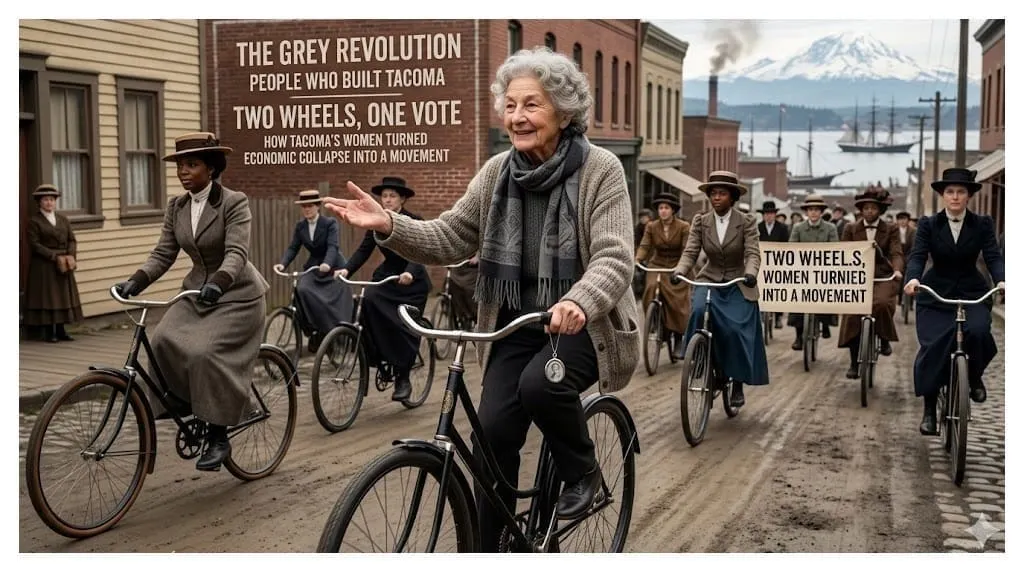
While the men who had built Tacoma's boom economy scrambled to save their banks and their dignity, the women of Tacoma did something different. They organized. They got on bicycles. And they quietly laid the groundwork for one of the most significant political achievements in Washington State history.
The City That Staked Everything on the Railroad
To understand what happened to the women, you first have to understand what happened to Tacoma.
Tacoma was incorporated in 1875 following its selection in 1873 as the western terminus of the Northern Pacific Railroad — a decision influenced by the city's neighboring deep-water harbor at Commencement Bay. The transcontinental link was completed in 1887, and the population grew from 1,098 in 1880 to 36,006 in 1890. Rudyard Kipling visited in 1889 and said it was "literally staggering under a boom of the boomiest."
The city's entire identity was built around a single idea: when rails meet sails. The railroad brought people and goods from the East; Commencement Bay shipped them to the world. As long as the Northern Pacific thrived, Tacoma thrived.
During the 1880s, American railroads had experienced what might today be called a stock market bubble. Investors flocked in, and expansion accelerated beyond what the underlying economy could support. By 1892, just 44 percent of all railroad stocks offered investors received a return on their investment. European investors began pulling out. When the Philadelphia and Reading Railroad filed for bankruptcy in February 1893, the cascade began. Before the crisis was over, 156 railroads would fail.
The Panic of 1893 thundered west from Wall Street, first clobbering San Francisco, then spreading its carnage up the West Coast. In Washington state, a run on banks ensued. Depositors withdrew their savings, converted them to gold when possible, and buried or otherwise hid them when they couldn't.
Tacoma, damaged so deeply by the depression in so many different ways, had perhaps the most difficult time recovering of any city in the state. It was unable to straighten out its municipal finances until mid-1900, and would never again seriously compete with Seattle for regional dominance.
The men who had staked everything on the railroad — the bankers, the land speculators, the merchants whose customers had vanished — found themselves with nowhere to turn. Credit was gone. Property values had collapsed. The civic swagger of the City of Destiny had been punctured.
But something unexpected was happening in the parlors and on the newly paved streets of the Stadium District and the hills above downtown. The women were getting organized.
The Bicycle and the New Woman
Innovative developments starting in the 1890s spurred cycling's popularity with both men and women, and soon bicycles were featured in songs, newspaper articles, and Fourth of July parades. The safety bicycle — the first design with two equal-sized wheels and a chain drive, recognizable as a modern bicycle — had arrived in American cities around 1890, and it changed everything for women.
Before the safety bicycle, women's mobility was controlled. You went where the streetcar went, or where your husband's schedule permitted. The bicycle changed that arithmetic overnight. In Tacoma, the Tacoma Wheelmen and their ladies built a trail system extending from the city to Longmire at Mount Rainier National Park by 1898 — over 50 miles on less than perfect paths. These were, by any measure, tough riders.
More than transportation, the bicycle became a social and political statement. Women who rode bicycles had to wear different clothing — the voluminous skirts and corsets of the Victorian era were incompatible with a bicycle seat. Bloomers and reform dress became symbols of a new kind of woman: mobile, independent, self-directed.
In Tacoma during the worst years of the economic depression, while men were losing their banks and their businesses, women were riding.
And while they rode, they talked.
The Club Movement and the Organizing Infrastructure
A vigorous women's club movement had begun to sweep the nation in the mid-nineteenth century, enjoying a heyday from the 1890s through the 1920s. Washington state women were no exception to the wide enthusiasm for informal volunteer societies dedicated to charitable efforts, self-improvement, and civic reform.
The club movement really started to take off in the mid to late 1890s up through the 1910s. These clubs helped form social policy. Women couldn't vote, they couldn't be involved in politics, but through these community service organizations they did shape policy in Tacoma.
This is the part of the story that most people miss. The women's clubs of the 1890s weren't social organizations in any casual sense. They were, in effect, a parallel civic infrastructure — a governance system built by people who had been deliberately excluded from the official one.
Club activity gave women a unique venue in which to learn and exercise new skills, helping give a public voice and influence to women even before they were enfranchised as full citizens with voting power.
In Tacoma, one of the most prominent figures in this infrastructure was Emma Smith DeVoe — born in Illinois, arrived in Tacoma via the same Northern Pacific that had built the city's boom. DeVoe understood something that the men scrambling to save their banks did not: that the economic collapse had created a vacuum of civic leadership, and that vacuum was an opportunity.
Also in Tacoma, Nena Jolidon Croake founded the Tacoma Woman's Study Club in 1899 and served as its president for three years. She later served as an officer in the Washington Equal Suffrage Association and worked with Emma Smith DeVoe in the 1910 campaign which resulted in women winning the right to vote in Washington state. Croake would eventually become one of the first two women elected to the Washington State Legislature.
These were not peripheral figures. They were the center.
The Suffrage Road and Its Obstacles
The powerful saloon lobby had pressured the courts, which in an 1887 decision found the suffrage law unconstitutional. Harry Morgan of Tacoma was a saloon owner who wanted to make sure that women had no vote, because he feared what they would do for his type of business. He was the backer of the case which was the first to officially deny women the right to vote.
Let that land for a moment. The primary organized opposition to women's suffrage in Tacoma was the saloon industry. The men who ran the bars feared sober, organized women. They were right to.
In 1898, suffragists again campaigned to restore women's right to vote in Washington, but were not able to pass the law. Demoralized, many suffragist organizations dissolved, and women's political organizing largely shifted to women's clubs.
This is where the bicycle clubs and the women's clubs become the same story. When the formal suffrage organizations collapsed after the 1898 defeat, the women didn't disappear. They regrouped in the same community infrastructure they had been building throughout the depression years.
When Emma Smith DeVoe began reorganizing suffrage organizations in 1906 as part of her efforts to revive the campaign in Washington, she turned to the women's clubs for support. With their assistance, the membership of the Washington Equal Suffrage Association jumped from 2 to 2,000, and by 1908, 75 suffrage organizations had been formed across the state.
The clubs that had kept women organized and visible through the economic devastation of the 1890s became the field organization for the suffrage victory of 1910.
Washington became the fifth state in the Union to permanently enact women's suffrage and the first state to do so in 14 years. The 1910 Washington victory is often seen as the event that revitalized the national suffrage movement and inspired the campaign that led to the passage of the Nineteenth Amendment ten years later.
What This Has to Do With You
Clara Vale is 68 years old. She has spent her career at the intersection of community organizing and policy. And she has thought a great deal about the women of 1890s Tacoma.
They didn't wait for permission. They didn't wait for the economy to recover. They didn't wait for the men who had failed them to rebuild something new.
They built their own infrastructure — clubs, networks, bicycle paths, study circles, petition campaigns — using the tools available to them. And when the moment came, that infrastructure was ready.
The Grey Revolution is not a new idea. It is the oldest idea in Tacoma.
When money became so scarce in Washington State in the 1890s, people in Bellingham and Port Angeles made their own. Jobless men sawed wood and picked blackberries. And women organized, rode bicycles, built clubs, and won the vote.
The tools have changed. The principle hasn't.
PromptSyndicate.ai — The Grey Revolution. One Last Fight for Longevity.