
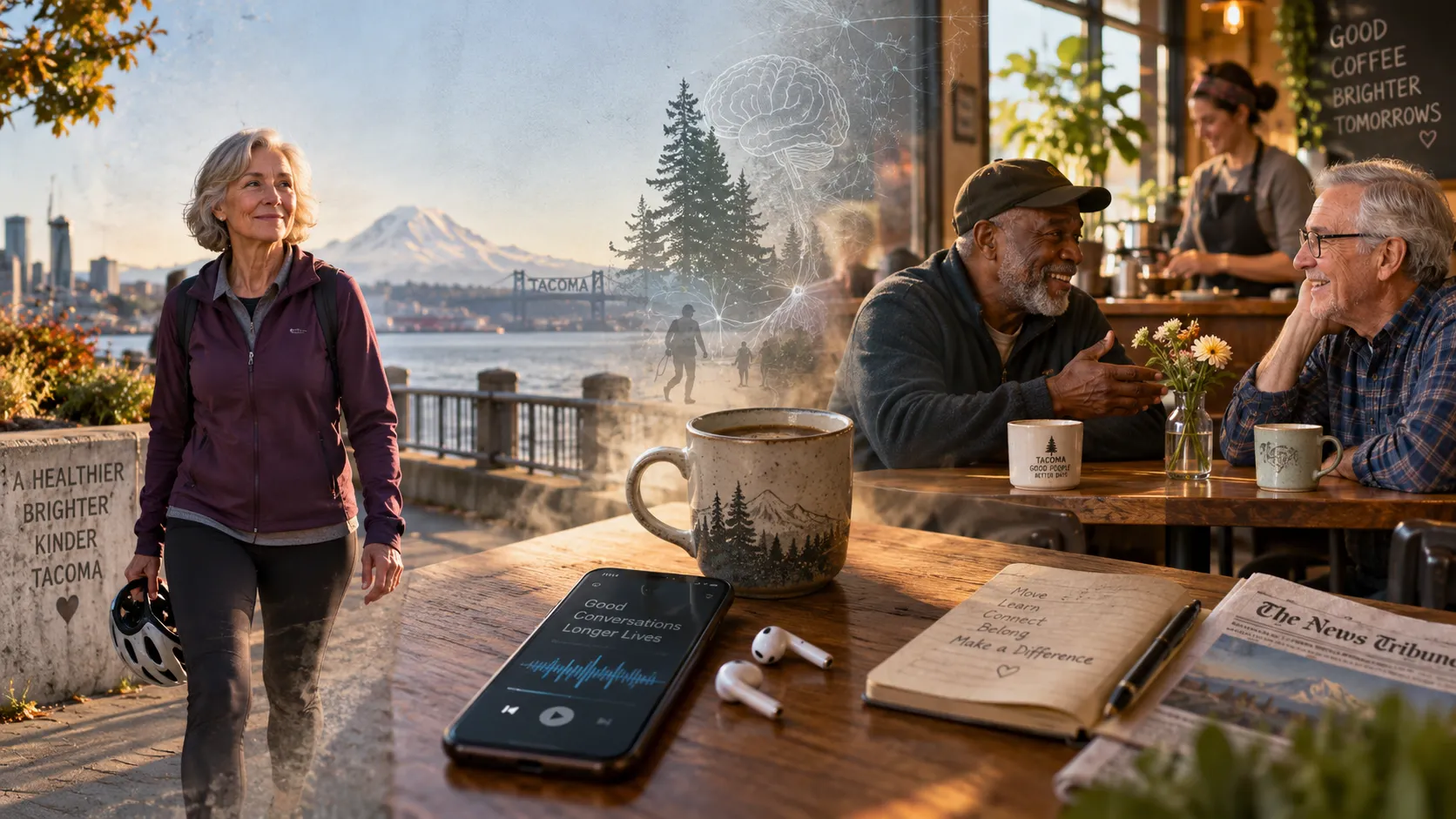
What a conversation with neuroscientist Richard Davidson made me think about exercise, purpose, connection — and the value of our Third Place
I listened to this conversation this morning because it begins with a question that gets more interesting as we get older:
If I have only so much time, why spend some of it meditating when I could be exercising?
Dr. Richard Davidson's answer is refreshingly practical:
You don't necessarily have to choose.
The conversation starts with physical exercise and meditation, but it becomes something much larger: a discussion of neuroplasticity, resilience, social connection, purpose, attention, inflammation, the gut, and what Davidson calls flourishing.
For those of us over 65, I think there is another way to hear it.
This isn't simply a podcast about meditation.
It is a podcast about how we use the years we have — and whether some surprisingly small habits can make those years richer.
The opening sets the tone. Davidson discusses research involving relatively brief daily contemplative practice and argues that mental and physical training do not need to compete for the same thirty minutes of our day.
That got my attention.
What's in the podcast
The full conversation runs about 1 hour and 42 minutes. I would encourage you to listen rather than treat this summary as a substitute.
Here are some landmarks worth listening for.
Around 1:39 — Meditation versus exercise
Davidson argues that vigorous aerobic exercise is one of the strongest established ways to encourage neuroplasticity. His twist is that neuroplasticity itself is neither automatically good nor bad — it increases the brain's capacity to be shaped by experience.
His suggestion is fascinating: combine physical activity with an intentional state of mind.
While putting on your shoes, beginning a walk, or starting a bicycle ride, think about why being healthier matters not only to you but to the people around you.
He calls the combination contemplative aerobics.
Around 5:22 — Loneliness and connection
This is where the podcast began intersecting with another subject I keep returning to: the coffee shop as a Third Place.
Davidson describes connection as one of the central ingredients of well-being.
A crowded room isn't necessarily connection.
Someone knowing your name might be.
Around 12:47 — Four pillars of well-being
Davidson organizes well-being around four trainable capacities:
Awareness.
Connection.
Insight.
Purpose.
Awareness means noticing what is happening now — including noticing what our own minds are doing.
Connection includes appreciation, gratitude, kindness, and compassion.
Insight involves recognizing that the running story in our head about "who I am" is a story, not necessarily an unchangeable fact.
Purpose means connecting ordinary life to something beyond ourselves.
Those four ideas become the spine of the conversation.
The part that particularly caught my attention after 65
At about 50:43, the conversation turns toward a research finding Davidson describes involving a modest daily practice.
He discusses a randomized intervention in which an average of roughly five minutes a day for 28 days was associated with a decrease in IL-6, a marker involved in inflammation.
That does not mean five minutes of meditation is a treatment for disease, and it certainly does not replace exercise, medical care, sleep, nutrition, or medication.
What interests me is the scale of the proposition.
Five minutes.
After 65, there can be a tendency to make healthy aging sound like another full-time job.
Walk this much. Lift this much. Eat this. Don't eat that. Sleep perfectly. Track everything. Learn something new. Stay social. Meditate.
Davidson's approach feels different.
What if we don't always need another appointment on the calendar?
What if some mental training happens inside things we're already doing?
He argues later in the conversation that the skills of flourishing do not require formal seated meditation. They can be practiced while exercising, commuting, doing laundry, preparing food, or moving through ordinary activities.
That sounds a lot more achievable.
Now let's take it to the coffee shop
This is where I would like to move the podcast out of the laboratory and into the neighborhood.
Suppose you are over 65 and every Thursday at ten you meet Jane for coffee.
The health story is usually told like this:
You walked to the coffee shop.
Good. Exercise.
You ordered carefully.
Good. Nutrition.
But perhaps something else happened that morning.
The barista recognized you.
Jane was already sitting at your usual table.
Someone asked where you were last week.
You listened to a story.
You laughed.
You disagreed about something.
You promised to bring an old photograph next Thursday.
None of that appears on a fitness tracker.
And yet connection occupies an enormous part of this podcast.
Later in the conversation, Davidson discusses social connection and longevity. He is careful about causality — healthier people may also be better able to socialize — while also pointing to intervention research suggesting that cultivating connection can itself produce health-promoting biological changes.
And suddenly our neighborhood coffee shop looks a little different.
It isn't merely where we buy coffee.
It can be practice space for connection.
The barista belongs in this story
That is also why I keep coming back to the modern barista.
The barista isn't your therapist.
They aren't responsible for curing loneliness.
But behind a neighborhood counter they often perform tiny acts of social recognition all day long:
"Good morning."
"The usual?"
"Haven't seen you for a few days."
"How did the ride go?"
"Jane's sitting in the back."
Those exchanges can look insignificant.
But perhaps after listening to this podcast we should be a little slower to call them insignificant.
The counter became a neighborhood stage.
And for someone later in life — particularly after retirement has removed the automatic social network provided by work — a Third Place can provide a little structure to the week.
Same table.
Same day.
Same faces.
New conversation.
Purpose after 65 may be smaller than we think
The part of the podcast I would especially recommend to an older listener begins at about 1:26:38.
The host asks Davidson what it means to have purpose.
His answer is useful because he strips away the intimidating version of the word.
Purpose doesn't have to mean starting a foundation, writing a book, climbing a mountain, or discovering one enormous mission for the remaining years of your life.
It can involve simple things done for your family, your community, or a cause larger than yourself.
Davidson calls this a transcendent purpose — something beyond oneself.
He gives the wonderfully ordinary example of cleaning his cat's litter box.
He reframes the chore: doing it helps the cat, helps his wife, and helps everyone who enters the room.
Same litter box.
Different meaning.
No additional time required.
The practical implication is what stays with me:
Purpose doesn't require waiting for something important to happen.
You can bring purpose to things already happening.
Making coffee.
Calling a friend.
Showing someone an old Tacoma photograph.
Checking on a neighbor.
Helping with a grandchild.
Joining a ride.
Remembering a story nobody else knows.
And perhaps even telling that story to the person sitting beside you at the coffee shop.
Try this over your next cup of coffee
I don't think we need to turn coffee into another wellness assignment.
But after listening to Davidson, I might try three questions the next time I'm sitting in a Third Place:
Awareness:
What is actually happening around me right now?
Connection:
Who here am I glad to see?
Purpose:
What small thing can I do today that matters to someone besides me?
That's probably five minutes right there.
No meditation cushion required.
No stopwatch required.
And perhaps that's the biggest idea I took from the podcast.
For those of us over 65, I would put it simply:
Keep moving.
Keep noticing.
Keep connecting.
Keep having a reason to show up.
And maybe have the coffee.