For most of human history, the question was whether you would survive long enough to grow old. That question has been answered. A new one has taken its place: what do we do with all this time?
Morgan Stanley's research team calls longevity one of the most transformative demographic and macroeconomic forces of our time. They are not wrong. But what the economists are only beginning to model, people over 60 have been living for years — navigating a world built for younger bodies, younger timelines, and younger assumptions about what a life is supposed to look like.
The Grey Revolution exists in that gap.
Living longer is not the same as living well. The difference is where the real story lives.
What the Numbers Say
Global life expectancy has risen faster in the past century than in all of prior human history combined. The implications are economic, institutional, and deeply personal. Pension systems, healthcare infrastructure, housing, and the financial planning industry are all being reshaped by a population that simply did not exist at this scale a generation ago.
Morgan Stanley identifies three sectors where longevity is already changing the investment landscape: healthcare and biotech, financial services and retirement planning, and the emerging longevity economy — the goods, services, and experiences specifically designed for people living longer, more active lives after 60.
What the Numbers Miss
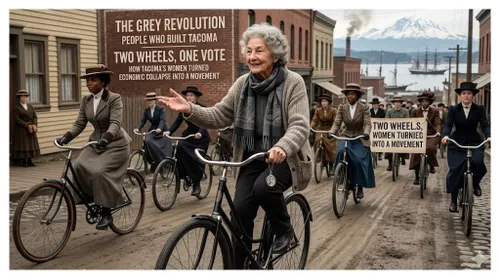
The macroeconomic lens, useful as it is, tends to treat longevity as a problem to be managed. A dependency ratio. A healthcare burden. A pension liability. What it rarely captures is what people are actually doing with the extra decades — the cycling clubs, the documentary projects, the community anchors, the third places where knowledge transfers between generations over espresso.
That is the story The Grey Revolution is built to tell. Not longevity as demographic trend. Longevity as lived experience, in Tacoma and everywhere else where people are figuring out what the second half of life actually looks like when you are still fully in it.
The Longevity Economy in Tacoma
On Saturday mornings at Wily Cycleworks on 6th Avenue, the Rápido Club gathers for a group ride to Point Defiance. The riders range from their twenties to their seventies. A man arrives on a vintage steel bike with a Brooks leather saddle. Young riders ask him about his racing career. He asks them about carbon fiber. Nobody is managing a dependency ratio. They are just riding.
That is the longevity economy the spreadsheets have trouble measuring. The social infrastructure. The knowledge transfer. The community that keeps people moving, connected, and mentally engaged — which, as the research consistently shows, is what actually extends healthy life expectancy.
The Research Is Clear
Exercise, social connection, purposeful activity, and continued learning are the four interventions most consistently associated with healthy longevity across cultures and income levels. None of them require a financial product. All of them require a community.
The Grey Revolution Health and Third Place threads cover this intersection — not as policy, but as people. The Movement as Medicine series documents Tacoma's Parkinson's community, drumming programs, and cycling clubs. The Silver Peloton series follows the riders at Wily Cycleworks. Brain Signals, with Warren Peters MD, translates neurological research into something a patient or family member can actually use.
The Morgan Stanley Piece Is Worth Reading
For the macroeconomic and investment context — the industries being reshaped, the sectors to watch, the financial planning implications — the Morgan Stanley analysis is thorough and accessible. It is the kind of big-picture framing that helps explain why what is happening in coffee shops and cycling clubs and community centers across Tacoma is not local color. It is the leading edge of something much larger.
The Grey Revolution GenAI + Health Thread
The Grey Revolution covers longevity, community, health, and the technology reshaping how we understand all three. The Brain Signals series goes deeper into neuroscience. The Silver Peloton documents cycling and community. The Movement as Medicine series covers Parkinson's, drumming, and exercise as medicine.
If you have a story, a resource, or a thread worth pulling — pull it.
thegreyrevolution.com · GenAI + Health threads · Tacoma WA