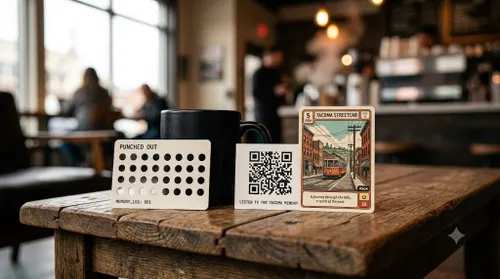
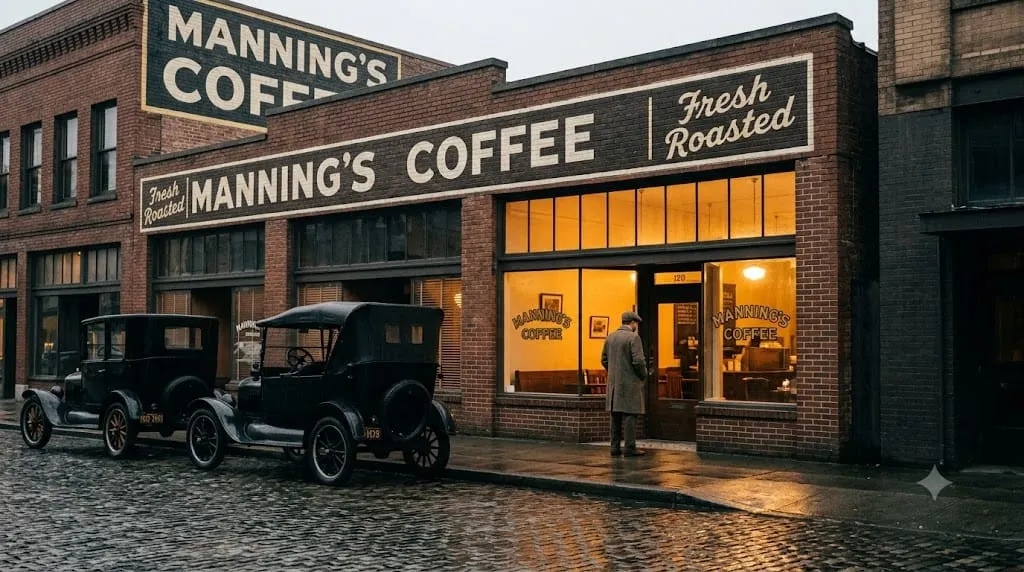
The vessels change, but the need to gather remains immutable. From the massive roasting urns of Manning's to the modern espresso bars of today, Tacoma's stories live in the warmth of a shared room. Scan the code on your screen or follow the link to explore our full deep dive archive on the history of Pierce County's original Third Places at TheGreyRevolution.com. Join the frontier.
Mae Rowan · Third Place Thread · The Grey Revolution
The story of the Pacific Northwest is written in water: the salt of Commencement Bay, the relentless grey mist that rolls off the Puget Sound, the glacial runoff of Mt. Rainier, and the dark, hot brew that has sustained the souls of Tacoma's working class for well over a century.
1900–1910s: The Cafe as Sanctuary
At the dawn of the twentieth century, Tacoma was a city forged in the fires of heavy industry, steam power, and timber. As the western terminus of the Northern Pacific Railroad, its identity was deeply blue-collar — longshoremen, mill workers, railroad laborers, and recent immigrants from Scandinavia, Germany, and Italy. The physical environment was harsh: clattering streetcars, soot-choked air from the smelters, and the omnipresent, bone-chilling cold of the Washington rain.
In this landscape, the early coffee house was not a place of leisure. It was a sensory sanctuary. When William and Edward Manning established Manning's Coffee in 1908, they recognized that the emerging industrial working class required a new kind of social infrastructure. The coffee shop provided something the crowded, damp boarding houses of downtown Tacoma could not: a clean, warm table, a blazing hearth of collective human presence, and a cheap cup of black coffee that bought a man the right to sit, think, and exist without selling his labor or his sobriety.
1920–1930s: The Scented Billboard and the Economic Lifeboat
The Manning's formula was a masterclass in sensory marketing and economic accessibility. They placed massive, gleaming commercial coffee roasters directly onto the retail floor — frequently right by the front windows, center stage in the dining hall. The roasters ran hourly. The sweet, rich, caramelizing aroma of roasting coffee beans was vented directly onto the foggy streets of downtown Tacoma, acting as an invisible, irresistible hook. The smell reached the street before you could read the sign. That was the whole strategy.
The menu was calculated: a hot, fresh cup of coffee cost a nickel. The cheap coffee drew people in, but the sight of the in-house bakery — churning out fresh pies, Heavenly Cakes, and morning rolls — drove the high-margin sales that sustained the business.
When the stock market crashed in 1929, this business model transformed Manning's into an economic lifeboat. For retirees, seniors whose life savings evaporated, and older veterans of the First World War, the cafeteria format offered an unparalleled sense of dignity. There were no waiters rushing customers to turn tables. A senior citizen could walk into the warm, brightly lit interior, purchase a single nickel cup of coffee, and sit undisturbed for three hours. The coffee shop ceased to be a luxury. It became a subsidized, collective living room for a generation hit hardest by economic catastrophe.
1940–1950s: Coffee Theatre and the 1954 Anchor
The 1940s brought wartime mobilization to the Puget Sound. Tacoma's Todd Shipyards and nearby Fort Lewis boomed with frantic energy. The postwar 1950s initiated a massive structural divergence: the birth of the suburbs and the automobile-centric lifestyle.
Yet downtown Tacoma's Manning's Cafeteria remained an unyielding anchor of urban civility. The interiors featured expansive plate-glass windows looking out onto rain-slicked avenues, catching the reflection of neon signs and the timeless silhouette of Mt. Rainier in the distance. Inside: deep, dark wooden booths, polished terrazzo floors, and walls adorned with expansive murals celebrating Latin American coffee agriculture — painted by artist Dorr Bothwell in what Manning's called the Costumes of Coffeeland series.
The counter workers were the orchestrators of high-volume hospitality. Long before the term barista entered the American lexicon, these women — and it was almost always women — operated massive, highly polished stainless-steel drip and siphon urns with precision and grace. They knew which elderly patron preferred their cream poured first. Who required an extra napkin for a trembling hand. Who needed a warm, patient word to break a day of crushing silence. For the senior demographic of 1954, these spaces were a vital anchor to their past. It was a space where an aging citizen was not a consumer to be processed, but a regular whose presence was woven into the very fabric of the room.
1960–1970s: The Generational Leveler
If the 1950s were about stabilization, the late 1960s and 1970s brought a seismic shock to the definition of the Third Place. Downtown Tacoma was undergoing severe economic strain as retailers fled to suburban malls. The massive, aging infrastructure of old cafeterias like Manning's began to share the urban landscape with a new breed of establishment: the independent, arts-driven, countercultural coffee house.
A profound sociological phenomenon occurred. The elderly residents of Tacoma — the retirees who lived in the downtown apartments and older neighborhoods like the North End — did not abandon the coffee shops. Instead, the coffee shop became the ultimate generational leveler. At the massive shared tables of these emerging bohemian spaces, the 65-plus demographic sat directly across from long-haired youths protesting the Vietnam War. They found an unexpected common language grounded in anti-establishment skepticism and a mutual love for the Pacific Northwest's isolation from the rest of corporate America.
1980–1990s: The Espresso Explosion
The closing of Manning's in 1984 marked the end of the old mid-century cafeteria era, leaving a temporary void in the urban social fabric. But that void was rapidly filled by the Espresso Explosion. Starbucks was expanding out of Seattle, but Tacoma developed its own distinct, fiercely independent espresso culture. Drive-thru espresso shacks began to pop up in gravel lots along Pacific Avenue and 6th Avenue. Gleaming, high-pressure Italian espresso machines — La Marzoccos and Nuova Simonellis — replaced the old institutional stainless-steel coffee urns.
For the aging customer over 65 during this period, the transition presented physical challenges. High, backless metal bar stools replaced low, wide wooden booths. Cramped, multi-level concrete steps replaced level, wide-aisle terrazzo floors. Stark halogen lighting replaced soft, ambient incandescent warmth. Despite these barriers, older Tacoma residents adapted. They claimed the few accessible low tables in the mornings, arriving hours before the student crowd. They formed tight-knit sub-communities, transforming the fast-paced modern espresso bar back into a slow-paced community anchor.
2000s–Today: The Return of the Roaster
As the calendar rolled into the 21st century, coffee was elevated to the status of an artisanal craft. In Tacoma, this movement found its physical home on 6th Avenue with the founding of Bluebeard Coffee Roasters — an intentional, brilliant return to the core ethos that had made Manning's so vital half a century earlier: the integration of production and consumption within a shared, transparent, and beautiful space.
Just as Manning's placed its giant roasters in the center of the room to broadcast its identity, Bluebeard anchored its expansive, light-filled space with a prominent roaster. The sweet, complex aroma of roasting single-origin Ethiopian, Colombian, and Sumatran beans once again blanketed the neighborhood, signaling a reclamation of Tacoma's industrial, sensory heritage. Massive floor-to-ceiling windows, wide-plank light wood tables, smooth concrete flooring that easily accommodated walkers and wheelchairs, and an abundance of natural light replaced the dark exclusionary tropes of the late 1990s.
On any given morning at Bluebeard, the demographic tapestry is breathtakingly complex. A 79-year-old retired longshoreman works on a laptop alongside a 22-year-old digital designer. The modern barista combines the lightning-fast technical precision of an artisan with the deep, empathetic social role of the old counter worker. They curate an atmosphere where an older regular is met with genuine respect, a perfectly pulled shot of espresso, and an acknowledgment of their vital place within the community.
The Thread
When we look back across the sweeping arc of Tacoma's coffee history, we see that the physical vessels have changed, but the human soul inside them has remained immutable. From the steel urns of Manning's to the custom-built espresso bars of today, the coffee shop has served as the ultimate democratic stage for Tacoma's evolving society.
For the aging population over 65, the Third Place is not a luxury or an optional destination. It is an essential pillar of psychological well-being, an antidote to isolation, and a physical manifestation of their ongoing citizenship within the community. It is a space where memories are preserved, where stories are passed down across generations, and where the relentless grey of the Pacific Northwest is kept at bay by the simple, profound warmth of a shared room.
This is Episode 1 of The Third Place — a six-episode series on Tacoma's coffee culture from 1908 to today.
Research sources: City of Tacoma archives · Labor Archives of Washington (UW) · Society for Commercial Archeology · lockekant.com
Mae Rowan covers the Third Place thread for The Grey Revolution.
Produced by PSEditor · The Grey Revolution · Tacoma, WA · Image assisted by AI
thegreyrevolution.com